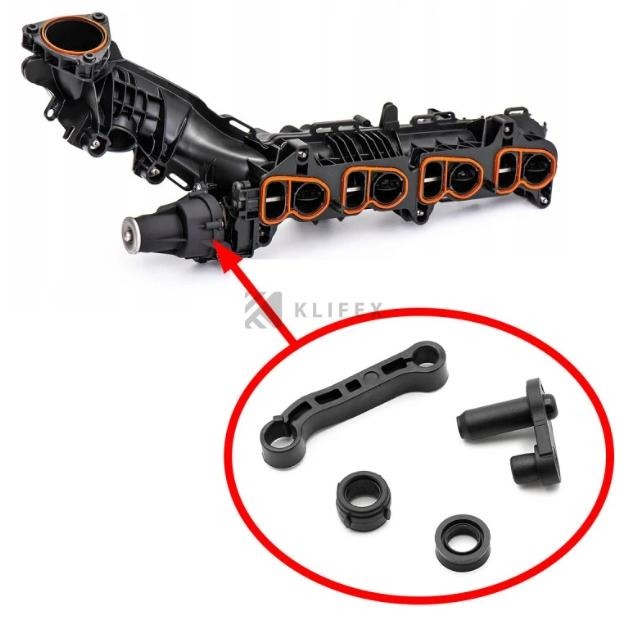
Modern intake manifolds often contain more than simple air passages. Many engines use swirl flaps, variable intake runners, linkages, bushings, and actuator mechanisms to control airflow under different operating conditions.
These components can improve combustion efficiency and engine response, but constant movement, heat, vibration, and contamination can eventually cause wear.
When problems develop, replacing the entire intake manifold is not always the first step.
Accurate diagnosis can reveal whether the fault is limited to a linkage, bushing, flap mechanism, or actuator-related component.
Understand How the Intake Manifold Mechanism Works
Swirl flaps are small plates positioned inside certain intake manifold runners. Their position changes according to engine operating conditions. A linkage usually connects several flaps, so they move together, while an electric or vacuum-operated actuator controls the mechanism.
Bushings support the moving shafts and connection points. Although these parts are relatively small, wear in one area can affect the movement of the entire system.
A typical mechanism may include:
- Swirl or runner control flaps.
- Connecting rods and linkages.
- Plastic or metal bushings.
- Clips and retaining components.
- Flap shafts.
- An electric or vacuum actuator.
- Position sensors or stops.
Check for Common Symptoms First
Worn intake manifold components do not always create an obvious mechanical noise. Engine behavior can provide the first indication of a developing problem.
Possible symptoms include irregular idle, reduced low-speed response, hesitation during acceleration, increased fuel consumption, or an engine warning light. Some vehicles may also store fault codes associated with intake runner or swirl flap position.
However, these symptoms can overlap with problems involving sensors, vacuum systems, EGR components, or carbon buildup. A diagnostic trouble code should therefore be treated as a starting point rather than automatic proof that the complete manifold has failed.
Inspect the External Linkage
Begin with a visual inspection of the accessible linkage while the engine is switched off and cool.
Look closely for disconnected rods, damaged clips, cracked plastic joints, or linkage arms that are no longer properly attached. Gently moving the mechanism by hand can also reveal excessive looseness.
A healthy linkage should normally move in a controlled manner without significant sideways movement. If one connection moves noticeably before the rest of the mechanism responds, a worn joint or bushing may be responsible.
Watch for Excessive Mechanical Play
Wear commonly develops where linkage rods connect to pivot points. Over time, repeated operation can enlarge these connections.
Signs of excessive play can include:
- A linkage that repeatedly disconnects.
- Loose-fitting joints.
- Uneven flap movement.
- Rattling around the linkage area.
- An actuator moving without fully operating the flaps.
If the manifold itself remains structurally sound, replacing the worn mechanism with a suitable kit for the intake manifold may be more practical than replacing components that are still functioning correctly.
Examine the Bushings
Bushings are easy to overlook because they may appear insignificant compared with the manifold assembly. Their role, however, is important because they keep shafts and linkage connections properly aligned.
Worn bushings may allow excessive shaft movement. During inspection, check whether the flap shaft moves sideways or vertically rather than simply rotating through its intended path.
Any visible cracking, deformation, missing material, or looseness around a pivot point deserves closer investigation.
Test Swirl Flap Movement
If accessible, observe how the swirl flap linkage travels through its operating range. The movement should be smooth and relatively consistent.
Resistance, sticking, or uneven movement can indicate carbon contamination, mechanical distortion, damaged flaps, or worn shaft components.
Avoid forcing a mechanism that does not move freely. Excessive force can damage plastic linkage parts or internal flaps and turn a repairable issue into a larger problem.
Compare Actuator and Linkage Movement
One particularly useful diagnostic step is determining whether actuator movement actually reaches the swirl flaps.
If the actuator operates but the linkage remains stationary, inspect the connection between them. A broken arm, worn socket, missing clip, or detached rod may be preventing movement.
Conversely, if the mechanical linkage moves freely by hand but the actuator does not respond when commanded, electrical, vacuum, sensor, or actuator faults may require further investigation.
Check for Carbon Buildup
Mechanical wear is not the only reason swirl flaps become difficult to operate. Deposits inside the intake system can restrict flap movement and place additional stress on rods and bushings.
A mechanism that feels unusually stiff should therefore be inspected for contamination as well as worn components. Simply replacing an external linkage will not solve the underlying problem if internal deposits continue to restrict movement.
Decide Whether Individual Components Can Be Repaired
The final diagnosis should determine both the failed part and the condition of the surrounding mechanism.
Replacing individual linkages, clips, bushings, or related components can make sense when the manifold body, shafts, and flaps remain serviceable. Complete replacement becomes more appropriate when there is extensive internal damage, severe shaft wear, cracked manifold sections, or multiple failures that cannot be reliably repaired.
Careful inspection is therefore essential. Diagnosing the actual source of play, sticking, or lost movement helps prevent unnecessary parts replacement while ensuring that the intake control system can operate correctly after the repair.

