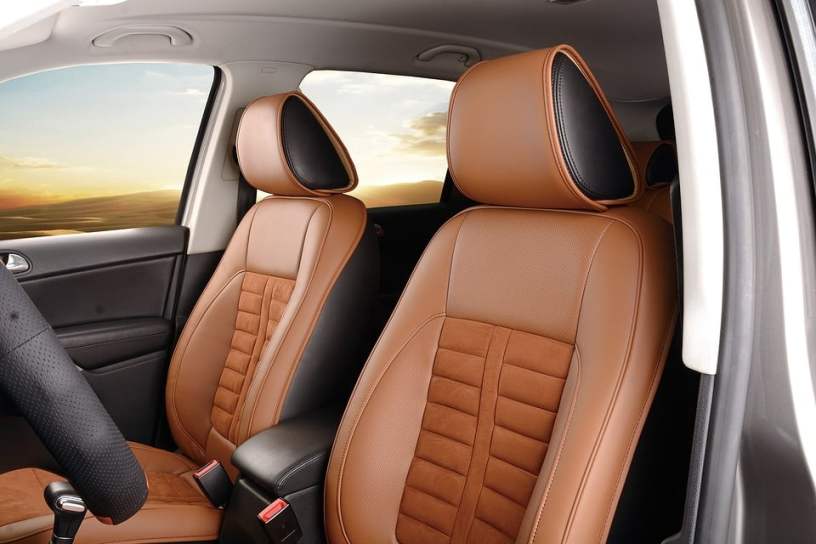
The automotive industry is evolving rapidly, and polyurethane (PU) car seat production remains a core segment of vehicle interior manufacturing.
For investors and manufacturers, 2026 brings both promising opportunities and potential risks. The critical issue is whether the projected costs and market conditions can deliver a satisfactory return on investment.
Global Automotive Market Outlook in 2026
Understanding the automotive production landscape is essential before evaluating investment feasibility.
Vehicle Production Trends
Global vehicle production has shown steady recovery and growth following supply chain disruptions in previous years. In 2026, several factors support expansion:
- Growth in electric vehicle (EV) production
- Increasing vehicle demand in emerging markets
- Replacement cycles in North America and Europe
- Expansion of localized manufacturing hubs
Major automakers such as Toyota Motor Corporation, Volkswagen AG, and BYD Company continue expanding production capacity, especially in EV segments.
Every vehicle requires multiple seating systems. As output increases, demand for PU seat foam follows proportionally.
Growing Demand for Lightweight and High-Comfort Seating
Automotive OEMs are increasingly focused on:
- Reducing weight to improve fuel efficiency and EV range
- Enhanced ergonomic comfort
- Improved durability and resilience
- Sustainable interior materials
Polyurethane flexible foam remains the dominant material due to its:
- Excellent energy absorption
- Comfort performance
- Customizable density
- Cost-efficiency compared to alternative materials
Regional Production Hubs
Vehicle production remains concentrated in:
- Asia-Pacific – China, India, Southeast Asia
- North America – USA, Mexico
- Europe – Germany, Eastern Europe
Emerging automotive hubs create opportunities for local Tier-1 and Tier-2 seating suppliers.
What Is Required to Start a PU Car Seat Production Line?
Launching PU seat foam production involves more than purchasing a single machine. A complete system is required.
Core Equipment
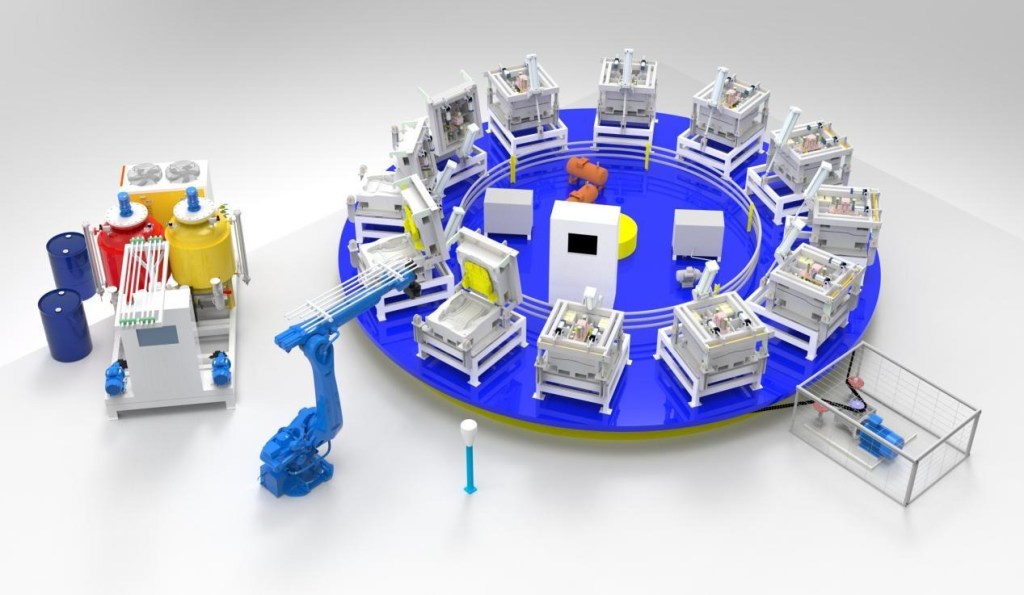
A standard automotive PU seat foam production line includes:
- High-pressure PU injection machine
- Aluminum foaming molds
- Carousel or conveyor system
- Raw material storage tanks
- Metering pumps
- Control and monitoring system
As a long-term polyurethane solution provider, Yongjia has supplied integrated injection and mold systems for automotive seating projects, focusing on injection precision and process stability rather than standalone machine sales. This integration is critical for consistent high-volume production.
Supporting Systems
Additional infrastructure includes:
- Curing area
- Mold temperature control units
- Demolding tools
- Quality inspection stations
- Ventilation and safety systems
Automation systems, including robotic mold handling, enhance productivity in large-scale production.
Investment Breakdown
Investment varies depending on production scale and automation level.
Estimated Initial Investment for PU Car Seat Production
| Production Scale | Equipment Investment | Mold Investment | Factory Setup | Total Estimated Budget |
|---|---|---|---|---|
| Small Pilot Line | $250,000–$400,000 | $150,000–$300,000 | $200,000 | $600,000–$900,000 |
| Medium OEM Line | $800,000–$1.5M | $400,000–$800,000 | $500,000 | $1.7M–$2.8M |
| Large Automated Line | $2M–$4M | $1M–$2M | $1M+ | $4M–$7M |
These estimates exclude land acquisition but include essential production equipment and infrastructure.
Equipment Cost
High-pressure injection machines account for a large share of the initial investment. While automation increases upfront costs, it significantly enhances long-term efficiency.
Mold Investment
Molds are critical assets. Automotive seat molds are typically aluminum with high precision machining.
- Single-cavity molds reduce upfront cost
- Multi-cavity molds increase output efficiency
Mold lifespan often exceeds 100,000 cycles with proper maintenance.
Infrastructure Requirements
Automotive PU production requires:
- Stable power supply
- Compressed air systems
- Explosion-proof configurations (when applicable)
- Temperature-controlled material storage
Operating Cost Analysis
Beyond capital investment, operational cost determines profitability.
Raw Material Consumption
A standard automotive seat cushion may consume:
- 4–8 kg of polyurethane foam per unit (depending on design)
Material costs depend heavily on:
- Polyol pricing
- Isocyanate market fluctuations
- Density specification
Stable injection precision reduces material waste and scrap rate.
Labor Cost
Labor requirements vary by automation level.
- Manual lines require more operators
- Automated carousel systems reduce labor cost per unit
Automation improves consistency and reduces human error.
Energy Consumption
Energy usage includes:
- Machine heating systems
- Hydraulic or servo motors
- Curing and ventilation systems
Energy-efficient machines lower long-term operating expenses.
Estimated Cost Per Seat (Medium-Scale Example)
| Cost Component | Estimated Cost Per Seat |
|---|---|
| Raw Materials | $28 |
| Labor | $6 |
| Energy | $3 |
| Maintenance | $2 |
| Overhead | $4 |
| Total Production Cost | $43 |
Actual costs depend on regional factors and specific material requirements.
Revenue and ROI Estimation
Selling Price
Automotive OEM contracts typically provide stable volume agreements. Seat foam pricing varies but may range:
$55–$80 per unit depending on complexity and region.
Gross Margin Example
Using conservative numbers:
- Selling price: $65
- Production cost: $43
- Gross margin: $22 per seat
If daily production equals 800 seats:
- Daily gross profit: $17,600
- Monthly gross profit (22 working days): $387,200
Simplified ROI Scenario (Medium Line)
| Item | Value |
|---|---|
| Total Investment | $2,000,000 |
| Monthly Gross Profit | $350,000–$400,000 |
| Estimated Payback Period | 6–12 Months |
Actual ROI depends on contract stability and operational efficiency.
Risk Factors in 2026
While prospects appear positive, investors must consider risks:
- Raw material price volatility
- Automotive market fluctuations
- Strict OEM quality standards
- Capital intensity and long recovery cycle
- Regulatory compliance requirements
Diversified customer portfolios reduce risk exposure.
Strategic Advantages of Investing in 2026
Several structural trends favor investment:
EV Production Growth
Electric vehicles require lightweight seating systems to optimize battery range.
Increased Comfort Standards
Consumers demand enhanced comfort, pushing OEMs toward advanced PU foam formulations.
Automation Efficiency
Modern injection systems reduce scrap rates and labor dependency.
Supply Chain Localization
OEMs are increasingly turning to local suppliers to minimize logistics risks and improve supply stability.
Companies like Yongjia focus on providing complete polyurethane solutions rather than isolated equipment. By aligning injection precision, mold design, and process support, integrated systems reduce startup risks and shorten commissioning periods.
How to Improve ROI
Profitability depends on operational optimization.
1. Optimize Mold Design
Efficient mold design shortens cycle time and improves foam distribution.
2. Invest in High-Precision Injection Systems
Stable ratio control reduces density variation and scrap.
3. Reduce Scrap Rate
Even a 2–3% scrap reduction significantly increases annual profit in high-volume production.
4. Plan for Scalable Expansion
Modular production lines allow gradual capacity upgrades without complete replacement.
Investing in PU car seat production in 2026 can be highly profitable—provided the project is strategically planned and efficiently executed.
Initial capital requirements are substantial, especially for medium and large-scale operations. However, stable OEM contracts, growing EV production, and sustained global vehicle demand create strong long-term opportunities.
The true determinant of profitability lies in:
- Accurate cost forecasting
- Stable injection precision
- Efficient mold design
- Controlled scrap rates
- Balanced automation investment
For investors capable of securing supply contracts and maintaining high production standards, PU car seat manufacturing remains a competitive and scalable industrial opportunity in 2026 and beyond.
 Auto Blog